
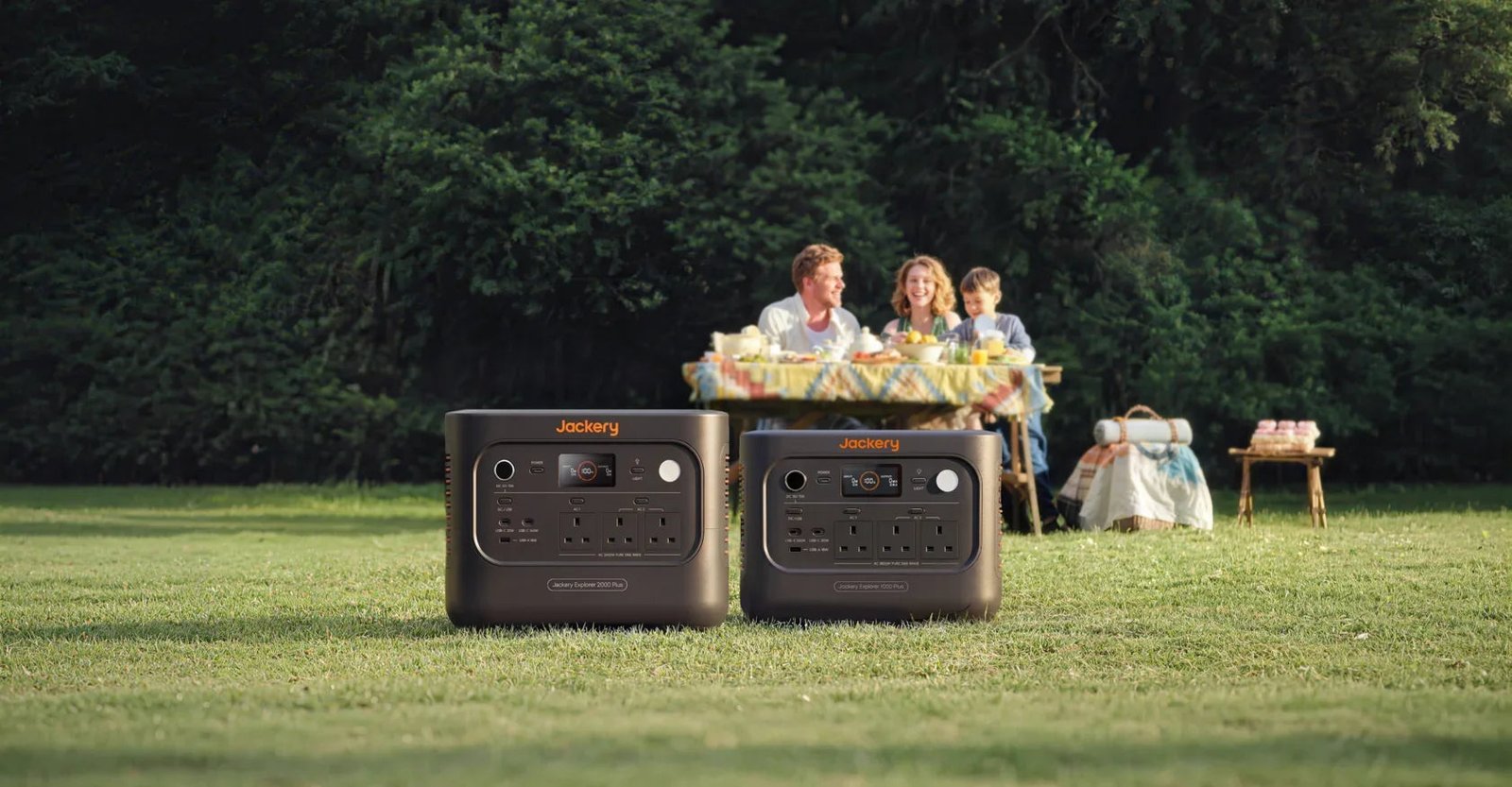
Jackery’s new Explorer Plus v2 range puts a familiar portable-power question back in the spotlight: how much battery do you actually need to carry? A smaller enclosure is welcome, but buyers should compare useful energy, output and charging arrangements before deciding that a compact power station is the right upgrade.
What has changed
In its October UK announcement, Jackery describes the Explorer 1000 Plus v2 and 2000 Plus v2 as smaller, lighter expandable power stations. The company lists 1,024Wh and 2,048Wh capacities respectively, with rated outputs of 1,800W and 2,400W. These are manufacturer specifications, not results from an AJ Techno Freak test.
Capacity and output answer different questions
Watt-hours describe stored energy. Watts describe power delivered at a moment in time. The first helps estimate how long a device might run; the second helps determine whether the station can operate that device at all. A unit can have plenty of stored energy yet be unsuitable for a demanding appliance.
As an illustrative calculation, a hypothetical 1,000Wh battery powering a constant 100W load would provide ten hours in an ideal loss-free system. Real use is shorter because conversion losses, the station’s own consumption and operating conditions matter. That calculation is a planning example, not a runtime claim for either Jackery model.
Build a load list before shopping
List the equipment you actually want to power, how many hours it needs to run, and whether devices will operate together. Charging camera batteries and a laptop for a short shoot is a different job from running several household appliances. The lighter option may suit one task while the larger unit is a better fit for another.
Port selection also matters. Check whether your equipment can charge directly over USB-C, whether the available power per port meets its needs, and whether sharing ports changes the output. A large headline rating should not replace checking the connections you will use.
Think about recharging and transport
Battery expansion adds flexibility, but also extra items to move and charge. Solar charging introduces another planning question: panel ratings describe specified conditions rather than a promise of identical output throughout the day. Consider where the equipment will be used and how reliably it can be recharged.
Our take: the attractive upgrade is the one that makes your actual kit easier to use. Compare complete carrying weight, connections, recharge options and local support before focusing on the smallest box. This is a buying explainer based on published specifications, not a product recommendation based on hands-on testing.
Source and product image: Jackery’s UK announcement, linked above. Availability and specifications can vary by region; check your local model before purchase.
Source used for fact-checking: https://www.theverge.com/tech/1023173/jackery-explorer-100d-portable-power-station-battery-lithium-iron-phosphate